Friday, May 29, 2009

TW Bogie Tanks Wagons

After some head scratching and discussion on Railpage – one of the internet discussion groups Australian modellers regularly use to nut things out I have begun.

TW part 1 005

Progress is at a measured pace largely due to the need to Araldite the brass to the underlying plastic frame. Tonight I have added the headstocks using “Slow Zap” CA which is a slower acting cousin of the dangerous “Zap a Gap” which could be relied to stick anything just where you don’t want it (such as another finger).

The headstocks needed some serious holding in place but there was no space to clamp so CA was the way to go and it seems to have worked.

Sunday, May 17, 2009

Cement and Railways – SCMRA Seminar

The Southern Cross Model Railway Association runs an annual thematic seminar on matters relating to modelling the railways of NSW. It is usually held in a community centre in Epping with a spit roast provided. I have been to a few – notably one with a just broken foot.

The topic for this year was Cement and the running order was:

Modern Day Cement Trains - Alex Nadalini

Cement Wagons -John Beckhaus

Portland Cement works -Howard Armstrong

Cement plants and their railways - Trevor Moore

Kitbashing a limestone wagon - Alec Warner

Weathering your Cement Wagons - Mike Crompton

Models for Cement - Trevor Moore

Modelling a Cement Batching Plant -Marcus Ammann

Smaldon the layout -Geoff & Ben Small

Closing Discussion -John Parker

It was a well run event and for me very useful in giving me lots of ideas about modelling approaches and techniques.
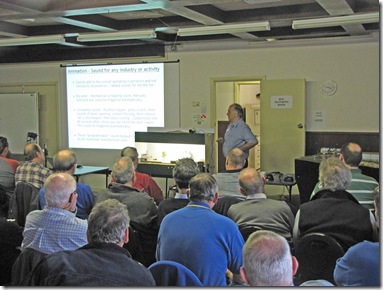
Bald pates

Here is Marcus Ammann’s presentation –this view unfortunately shows off the bald pates of the audience!

A sample of the model rolling stock is below.

Cememn models

Cement works

I am not sure who is doing this but a cement works is under construction in HO and it looks pretty good.

Below is one of the curves on Smaldon Curve.

Smalldon Curve

This model shows what you can achieve with a simple concept. Better still it was completed one of a number of models Geoff Small has completed to exhibition standard(roughly 1 every 2 years).

Tuesday, April 28, 2009

Strange Beauty

Sydney Water statues These three beauties were sculpted by Mr W.P. Macintosh of Annandale and were erected at the new offices of what was then Metropolitan Board of Water Supply and Sewerage, in Sydney (1918).

The figures represent (from L to R) : The City of Sydney (notice the resemblance to Clover), Aquaria symbol of the water supply and Hygeia symbolising water supply (as she holds a cog and ewer). There is no symbol for sewerage so it is left up to our imaginations.

All this seems right an proper and done in copper (during a World War when copper might have better uses). Imagine the fuss if Sydney Water tried to do a similar thing today.

Sunday, April 26, 2009

Photos of the Edwin Davey Weighbridge

Here are some photos of the remains of the rail weighbridge used by the Edwin Davey Flour Mill.

Report F1

This is the Flour Mill building sitting on the sandstone escarpment. The siding was located in the middle ground where the fence is. The weighbridge and loading facilities were located roughly where the graffiti can be seen.

The overhanging part of the building is where the grain was elevated to.


Report F2 This is a view from the top of the escarpment looking down on the rail weighbridge. You can see the weighbridge itself and remains of the balance and evidence of underground loading facilities.

Report F3

This is a close up shot of the weighbridge and balance. The weighbridge was made by the Australasian Scale Co, Sydney which were associated in some way with Avery’s the British scale manufacturer. You can see artefacts associated with graffiti art discarded on the ground.

The Edwin Davey Flour Mill and its rail connection

I have been doing a heritage assessment on the rail weighbridge that served the Edwin Davey Flour mill in Pyrmont. The Mill which was established c1890 and taken over by Edwin Davey in 1900 was connected to the Darling Harbour Goods line when it was constructed c1922.

The siding was cut into the sandstone escarpment on which the mill stood creating space for several wagons and a rail weighbridge. Wagons presumably were weighed and then discharged into underground bind that conveyed the wheat to bucket lifts that took the wheat up the escarpment to the storage silos in the mill. There is no evidence that the Mill discharged flour into rail trucks.

Mill 2

This is an undated photo of the siding and the mill. From the ‘newish” look of the exposed sandstone cutting it must have been taken when the siding was newly opened. If you look closely you can see that the wagons on the street outside are horse drawn.

What is interesting about the place is that later a connection was made to the Sydney City Council’s depot which seems to have been established in an old quarry (probably “Hellhole”).

I haven't been able to establish a date for the siding. If you look at the website for the City of Sydney archives (http://www2.photosau.com/cityofsydney/scripts/home.asp) you can search on Wattle Street and see pretty much all their photos. The earliest ones date to 1931 and show the siding with wagons “in situ” (e.g. SRC 13736). It looks like that the Council had established an asphalting plant on the site which was located at the rear of the site next to the quarry face and which was loaded from Jones Street.

The railway wagons seem to have discharged from their elevated track onto the area at the base of the asphalt plant. Later there was some sort of cement making plant as well. It seems obvious that the wagons (only 4 wheelers have been seen) brought in material for Council use.

Flour Mill plan

This plan taken from the current Parish Plan shows the layout of the Council’s siding and the rather complex shunting required from the Flour Mill siding. There wouldn't be much room for traffic so presumably the trains were short or stood on the main line while portions were shunted.

The Council siding seems to have lasted until at least 1970 – it is not there in 1973 I think. The siding to Edwin Dave lasted until 1995 – I even saw a 48 class hauling some wagons from the siding when I first moved up here.

My thoughts about this area also drift to what an interesting little model railway this would make.

Any further information on the topic would be most welcome.

Tuesday, March 24, 2009

D51714 preserved at Kagoshima

These are images of a preserved locomotive I found next to our hotel (the Sun Royal) at Kagoshima (photographed 12th February 2009). The address is Yojiro, Kagoshima City just up from the hotel, across a small street (Google maps .

D51 is a type of 2-4-2 steam locomotive (the wheel arrangement is called a Mikado) built by the Japanese Government Railways, the Japanese National Railways and various manufacturers from 1936 to 1951. The design of D51 was based on D50 which was launched in 1923. A total of 1,115 D51 locomotives were built. Early D51s built were known as "Namekuji type" (or "slug").

The number consists of a "D" for the four sets of driving wheels and the class number 51 is one of the series for tender locomotives that the numbers 50 through 99 were assigned to under the 1928 locomotive classification rule.

Several of the D51 class survive. A D51, D5122 stands outside the Yuzhno-Sakhalinsk Railway Station Sakhalin Island, Russia having been captured during World War II Another D51 , D51231 stands outside the National Science Museum in Tokyo.

The loco is preserved with some track and a signal.

Morning at Exile Bay

There is something good about our early morning walks with Alistair along the footpath along Exile Bay. The sun, the water and the clear skies make this a wonderful time and experience. Sun just comming up

Here is the sun arriving over Abbotsford with smooth water, the boats bobbing and the somewhere out there a rowing boat training and coach hurrying them on.

Exile Bay Sunrise

Later the sun lights up the sky and the ridges; colouring the water.

Walking back

On the way home to a well deserved coffee and dried dog food. The Bushell’s factory is in the background – last of the industries along the waterfront in Concord.

I think we are lucky or blessed to be able to do this walk every day.