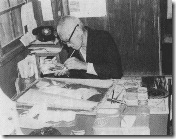
This is Yamamoto Sakubei one of the most stunning artists in the area of industrial heritage I have ever seen. I am not sure of his story but his art – in the form of pre-Manga drawings - documents life in the coal mines of Tagawa in the Chikuho region of Fukuoka on the island of Kyushu. I know very little about him except that he was an ex-coal miner. I was sent a book of over 500 of his drawings and saw more at the Tagawa City Coal Mining historical Museum. 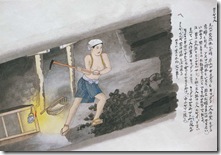
Here we see a typical drawing of a woman mining a coal seam. There is text describing the drawing (I wish I could read Japanese) and the drawing is quite detailed.
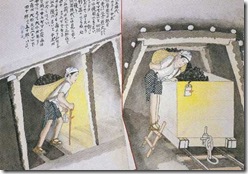 On the right another miner is shown taking the coal to a skip. Women and men worked together in Japanese coal mines until the 1930’s. The work was really tough as there was little mechanisation in the mines until after the Second World War. Yamamoto Sakubei seems to document the gradual mechanisation of the mines.

This image shows the equipment of the Japanese miners although it should also be noted underground because of the heat very little clothing was worn.
The collection of drawings is not only an important documentation of the work involved in mining but is also quite poignant in its depiction of what was a hard and dangerous life.


