Showing posts with label heritage. Show all posts

Monday, November 29, 2010

Lidcombe

I had a little project in Lidcombe (NSW). I had never really been there before. I’d been through on the train but on foot I found a neat little shopping centre. Compare this photo looking down Joseph Street taken c1941 with a photo taken in November 2010

Lidcombe

From Wayland, S. C & Lidcombe (N.S.W. : Municipality). Council 1941, Lidcombe and its development as an industrial centre Council of the Municipality of Lidcombe, Lidcombe, N.S.W

(source Wayland, S. C & Lidcombe Council 1941, Lidcombe and its development as an industrial centre, Council of the Municipality of Lidcombe, Lidcombe, N.S.W)

Railway hotel, Lidcombe 

Not much has changed except for the cars and the car parking. Quite refreshing to find these gems.

Friday, April 23, 2010

It is a long trip to Broken Hill

As an outback town Broken Hill is reckoned to be not all that far away and from a South Australian perspective maybe it isn't, but from Sydney it is a long drive and for the organisers of the 2010 Outback and Beyond Conference is has also been a long 18 months or so. So here we all are ICOMITES and TICHS waiting for the Conference proper to start.

To get here I forsook the plane and the train for my car and the back roads of NSW. I decided on the route through Cowra, West Wyalong, Rankin Springs, Hillston and Ivanhoe. Leaving at 6:30 I got to Ivanhoe by 5:30. Ivanhoe was quite desolate so I decided to push on to Menindee some 200k by dirt. I stayed the night at the Menindee Caravan Park.

The landscape from West Wyalong onwards was essentially flat with the odd range of hills. We had been promised plagues of locusts and while swarms were not obvious there were enough locusts to force several window cleaning stops. The locusts are a sign of the good rains we’ve been having this year.

Another sign is the flooded Menindee Lakes refilling from Queensland flood waters from the Darling River.

Menindee has the lakes (a series of lakes with lunettes) and the Darling River. It was for a time the terminus of the standard gauge line from Broken Hill which reached Menindee in 1919. There it stayed until a lifting bridge (for the river boats) was completed and the line through to Dubbo and the rest of the NSW rail system was completed.

This is the bridge in question, shorn of its concrete weight that provided the counter balance to allow the bridge to open but also showing in the foreground the pump inlet – I think for the water pipe to Broken Hill.

After driving around Menindee i headed west towards Broken Hill. About half way Stephens Creek in encountered and after that the first sign of my destination – the Barrier Silver fields could be seen.
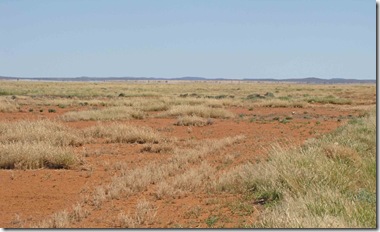
The blue line of the distant ranges. Therein lies the richest sliver lead zinc lode and 125 years of Australian mining history and of course heritage.

Wednesday, December 16, 2009

What is this?

The following are photos of some machinery located beside a railway track (between two inspection pits) at the former Clyde Wagon Workshops.

One one side is this object which seems to be operated by some sort of air cylinder (it looks quite a bit like the air brakes under a wagon).

Clyde029

Clyde edited-1

On the other side (i.e. opposite) is this item

Clyde014

I thought that they might be some sort of retarders except they are on the wrong side of the track!

This area was used to do heavy repair of four wheel wagons so I am assuming it relates to this work.

All ideas welcome.

Tuesday, April 28, 2009

Strange Beauty

Sydney Water statues These three beauties were sculpted by Mr W.P. Macintosh of Annandale and were erected at the new offices of what was then Metropolitan Board of Water Supply and Sewerage, in Sydney (1918).

The figures represent (from L to R) : The City of Sydney (notice the resemblance to Clover), Aquaria symbol of the water supply and Hygeia symbolising water supply (as she holds a cog and ewer). There is no symbol for sewerage so it is left up to our imaginations.

All this seems right an proper and done in copper (during a World War when copper might have better uses). Imagine the fuss if Sydney Water tried to do a similar thing today.

Saturday, February 28, 2009

The Nagasaki Hammerhead Crane (again)

I am posting another picture of the crane because the one earlier taken from Glover Garden (グラバー園) house was during a rainstorm and required quite a bit of Photoshoping to get clear.

This photo is clearer but suffers from being taken from inside the shipyard so it was difficult to get far enough away to get a good shot. The rain didn't help either.

The Mitsubishi Shipyard didn't seem to worry all that much about us wandering around.

There is also an excellent Museum on site which was well worth visiting.

Saturday, February 14, 2009

Ships and Cranes

The Mitsubshi shipyards were an important industry in the Nagasaki area. They were established as the Nagasaki Ironworks in 1857 with help from Dutch naval engineers as a government facility. However after the Mejii restoration the shipyards were run by Mitsubshi-sha headed by Yanosuke Iwasaki.


There is an excellent museum on the site in the former wood-pattern shop. This contains a number of pieces of important machinery and documents relating to ship construction.

Of course the discovery of a 1909 Hammerhead Crane by William Arrol still working in the Mitsubishi shipyards was a plus as was the fact that we could go in and photograph it.


Friday, February 13, 2009

Knacked in Nagasaki

Its been a wet day in Nagasaki today. After viewing the commuter rush we headed out to view the "battleship island" , Hashima Island, (sometimes also called Gunkanjima Island) our trip was cancelled due to bad weather but we went to a rather ordinary museum on the subject instead. We could see the island from the coast.


Apart from these photos we learned nothing new and wasted the morning being led astray when there was so much more to be seen. We drove back into town where after a brief stop at a telegraph station we went to the Kosuge Ship repair dock. This dates from 1868 and was the first patent slip in Japan. The slip and the engines were modernised in 1937 but the original engine and 1901 boiler are still there. This is a realy great site with lots of interest. Of course I had to find mud to step in and dust to lean against much to the amusemt of our party.