Wednesday, January 25, 2012

Experimenting with location

I am experimenting with adding the location of a post to this page.

Cockatoo Janes 053

Here is a picture of a slightly belligerent seagull at Cockatoo Island.(taken November 2007)

Map picture

This is a good approach although it is difficult to pin point exactly where the seagull was.

Map picture

The Bing Map is at its max zoom in and it is really difficult to insert the pushpin.

As I edit the posts using Windows Live it will only accept MS’s silly Bing maps (have you ever heard of a sillier name?). Anyway the experiments continue.

Saturday, January 7, 2012

The Cannon that isn't the one at Yeppoon

Following on from the previous posts showing a 6” Breach loading Armstrong gun on a hydro-pneumatic carriage, I thought I’d tell a bit of the story of the cannon that features in the Yellow Pages add. The add shows a cannon inspector inspecting a large gun and commenting that “one of these went off at Yeppoon a few years back”.

The gun being measured is one of two 1867 Armstrong RML guns on the foreshore at Williamstown (there are two more at Fore Gellibrand). RML stands for rifled muzzle loader and therein lies the story.

Newcastle (UK) industrialist and inventor William Armstrong was inspired by reports from the Crimean War to develop improvements to British artillery. There are three major improvements attributed to Armstrong; the use of rifling, breach loading and the “build up” method of construction using wrought iron hoops. These produced a lighter more accurate artillery piece and Armstrong’s weapons were tested and adopted in the period 1855-58. 

The original weapons were smaller pieces such as 40 pounders but despite some misgivings about the forces involved Armstrong was persuaded to make 110 pounders for the Royal Navy without trials.    

During the bombardment of these fortifications at Kagoshima in 1862 some of the Royal Navy’s Armstrong guns suffered from the breach mechanism failing.

By this time some improvements were made in shells which facilitated the muzzle loading of rifled guns and Palliser developed a method for inserting wrought iron rifled barrels into old cast iron cannon converting them into rifled muzzle loaders so the Armstrong breach loader was discontinued and Armstrong produced RML weapons from his factory at Elserwick. He produced some very large weapons indeed probably reaching the limits of what was practical using gunpowder and wrought iron.

80 pdr RML Guns at Williamstown

Here is one of the Williamstown guns in all its glory.

80 pdr RML Guns at Williamstown

But lacking any real context.

80 pdr RML Guns at Williamstown

It is easy for the “Battlefield Archaeologist” when the manufacturer puts so much information on the weapon.

The Armstrong guns mounted on the H-P mountings were a generation on from the RML’s they had a new improved breach mechanism and were made from steel.

Steel? Well in the 1850’s steel making on a large scale only had just been developed with the development of the Bessemer converter but a decade or more was needed to develop a steel that would take the stresses in artillery tubes so the original Armstrong guns were wrought iron.   

Thursday, January 5, 2012

More Taiaroa Head

The breach of the Disappearing Gun was working so I borrowed Janes camera and took some video of the guide (and I think Neville Ritchie) operating the breech.

Closing the breech
Locking
The development of a successful breech mechanism was the key to development of modern artillery. Armstrong’s original breech-loaders exploded at the Battle of Kagoshima in 1862 (part of my Japanese work) setting back development several decades. I thought showing the breech on a later gun might be of interest.

Thursday, December 8, 2011

The Disappearing Gun - Taiaroa Head, Otago Peninsula, New Zealand

The Disappearing gun is a familiar and intriguing weapon mounted in major fortifications in Australia and New Zealand. It was the outcome of mid-19th century technological advances in weaponry such as the increasing size and power of marine and coastal artillery, the development of armoured steam ships negating the defensive power of tides and wind and the development of operational research analysing the impact of Civil War bombardments of coastal forts and the results of the famous battle of Alexandria (in 1882). All this work lead to the conclusion that coastal artillery needed to be better protected if only to preserve the crews serving the weapons. This conclusion resulted in a variety of new fortification and gun mounting designs which were developed from the mid-1860s.

A disappearing gun is one where a rifled, breach loading, gun is mounted on a hydro-pneumatic carriage in which the recoil is checked by cylinders containing liquid and air, the air when compressed furnishing the power for restoring the gun to the firing position. The gun was swung above the parapet of the mounting and pointed and elevated from below and then fired. The recoil swung the gun below the parapet where it was reloaded. A metal (armoured) shield covered most of the gun pit in British designs. The crew was protected below the parapet and the gun itself would have been a difficult target to hit.

The British design used throughout the colonies was by Armstrong a company with expertise in hydraulics and of course pioneering the breach loading design. The “Disappearing Gun” was sold to the colonies in the mid 1880’s as well as to China and Thailand. A similar design the Buffington–Crozier Disappearing Carriage was adopted by the United States for coastal artillery from the mid-1890s and some saw service against the Japanese.

Gun Front

The gun in its loading position. The gun can be trained using the wheel visible in the photo. The band around the mounting gives the angle.

I was involved in looking at the fortifications in Victoria in the 1980s when hydro-pneumatic mountings were discovered and there were plans for reconstructing South Channel fort. I had also seen batteries in Sydney and Queensland where disappearing guns were mounted. I knew of the batteries at North Head at Auckland which I had briefly visited and that there were other batteries at Canterbury. Curiously each State claims their battery was the first or prototype mounting!

During the 2011 Australasian Society for Historical Archaeology Conference the pre-conference tour visited the Otago Peninsula. At Taiaroa Head, which dominates the narrow entrance to Otago Harbour, extensive fortifications were constructed following the usual fears of a Russian invasion. In 1885 the New Zealand Government bought 10 8” and 13 6” disappearing guns from Armstrong’s Elswick 0rdnance Company. The gun at Taiaroa Head is a 6” with a range of about 6600 ft. The propellant used was initially gunpowder and the shells were the typical range of shells using gunpowder. Later Cordite MD was used as a propellant and presumably more advanced shell were used.

Although obsolete by 1900 in New Zealand they were manned during World War 1 but abandoned about 1925. However unlike other guns the gun was not cut up for scrap metal and was recommissioned during World War 2, and later completely restored by the Otago Antique Arms Association. The mounting site is amid an Albatross colony.

gun shield  Detail of the shield protecting the crew from shrapnel.
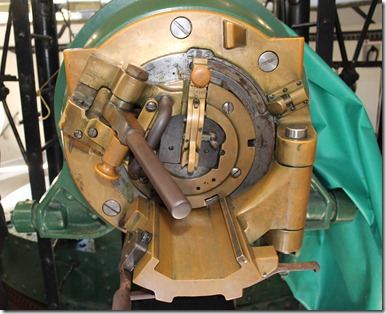
Gun Breach 2

The breach in its closed position.

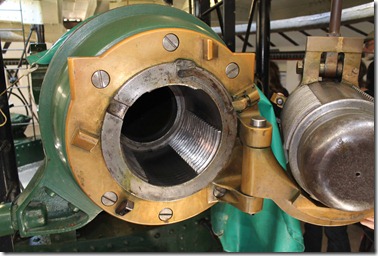
Breach of gun

The breach open showing the screw mechanism.

Saturday, August 20, 2011

Getting people involved in the hobby

What is the purpose of a model train show? To me it seems to serve two main purposes; firstly, to show off our hobby and secondly to encourage and inspire people to joint in. While there is allot of dispute about how to do this (and while I have some views myself about presentation of layouts) I wanted to post about one person who seems to be getting people involved in a practical and fun way. I am referring to Geoff Nott.

Geoff and his friends runs hands on scenery making demonstrations mainly for kids at many of the Sydney model railway shows

Hands On Scenery Demonstration - Geoff Nott and friends. Geoff in action

Geoff at work at the Castle Hill show (note the enthusiastic kids and parents).

Hands On Scenery Demonstration - Geoff Nott and friends. Examples of his techniques.

For the more restrained there are also displays of how to convert odds and ends into wonderful scenery.

I think this approach is really where model railway shows should be going namely; involving the general public in the hands on aspects of the hobby to get them to feel that model railwaying is more than a few greying over 50’s blokes chatting with their mates.

It helps that Geoff is a friendly bloke who seems always ready to pass on his considerable skills in modelling.

Sunday, July 31, 2011

A long time ago at Lake Condah

LCD 300dpi Edited

This is the crew at the excavations of the Lake Condah Dormitory run by the Victoria Archaeological Survey in December 1986. The photo was taken on the 20th December and I found it today in some files.

I am going to have a go at some names but not the spelling!!

Top

David Clark, Chris West, Noel Pearce, ??, Robin Stocks, Albert Clarke?? Arthur Cole, Peter Fergusson, Jenny ??, John Evans, Andrea Warren, David Rhodes, Gary Nelson ,Mike McIntyre, Katrina Geering, Cathy McIntyre

Bottom

Jill Gallaher, Stewart Simmons, Rebecca Barry, IMS, Fiona Weaver, Min Ho, Brenna McIntyre, Barry Golding.

I am open to corrections, additional information and comments.

Saturday, July 9, 2011

The mysterious 8118

A favourite place of mine to spot trains is the Carrington coal loader at East Mayfield.this area is adjacent to the old BHP Steelworks – the main boundary road is Selwyn Street. Selwyn Street crosses a railway line – leading, I think, to the One Steel wire works.

On this siding on 27th January 2009 was 8118

Newcastle Jan09 8118

Several years later I returned to the same area – in fact last week was the same locomotive in the same place!

East Mayfield 8118

It was still there on the 7th July two days later.

Newcastle01 8118

The question I had was – had it ever moved! But a check of Nearmap and Google Earth showed it was not there several times between now and 2009 and it seems my observations were merely coincidence. However it is interesting to spot the changes over the last few years.